Guides
The Interchangeability Test: How to Audit Your Brand for Real Differentiation
Most brand audits measure internal alignment when they should test interchangeability. Learn how to run a rigorous brand differentiation audit to prove your unique strategic positioning in a crowded market.
Ines Calloway
Sep 2026 · 8 min
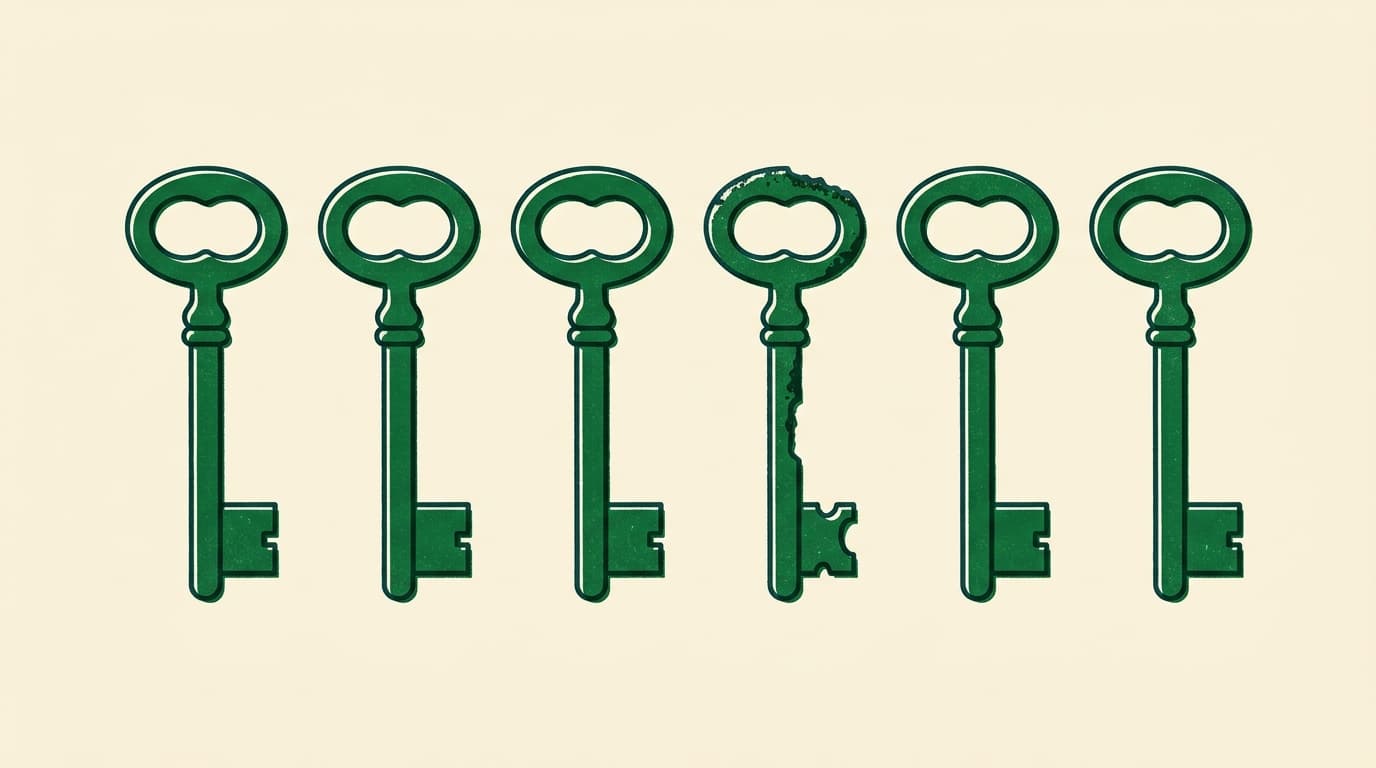
Most corporate audits are designed to confirm what you already believe. They check if your colors match and if your logo is centered.
This is a waste of time. A brand audit that only measures consistency is a vanity exercise because it ignores whether you look and sound exactly like everyone else. If your prospects can swap your competitor's name into your website copy without changing another word, your strategic positioning does not exist.
The copy-paste diagnostic
The illusion of internal alignment
This strategic failure usually starts with an obsession over style guides. Teams spend weeks checking if the brand identity is applied uniformly across slide decks and social graphics. This creates a comfortable illusion of progress.
Yet, this internal agreement says nothing about your position in your space. You can have a perfectly aligned set of assets that fails to register with prospects. Alignment without distinction is just coordinated noise.
When you prioritize compliance over competitive distance, you end up with polished messaging that says absolutely nothing unique. Your customer perception suffers because you look like a generic vendor. You have confused order with impact.
Clean layouts cannot save boring strategy.
How interchangeability reveals weakness
The real test of your messaging is a diagnostic called the interchangeability test. It asks a single question: if you stripped the logo from your homepage, could a rival use it? If they can, you have failed to build a competitive advantage.
When everything is interchangeable, your target audience cannot find a logical reason to choose you. They rely on superficial signals like price or size to make their decision. This diagnostic forces you to look at the cold reality of your copy.
Most firms avoid this test because the results are uncomfortable. It exposes the fact that their copy is built on shared assumptions rather than unique truths.
It is easier to argue over hex codes than value — and everyone in your marketing department knows it.
Why consistency is a false metric for differentiation

The gap between polished and distinct
This discomfort stems from a deeper misunderstanding of what a brand is supposed to do. For years, B2B leaders have been told that consistency is the holy grail of brand management. The logic seems sound on its surface.
Industry guides, such as frontify.com, argue that maintaining a uniform experience helps build customer retention and lower acquisition costs. Granting that — consistency prevents confusion. A polished, reliable presentation is table stakes.
But a highly consistent brand can still be entirely generic. You can buy a massive share of voice with perfect visual identity coordination. If that message is boring, you have simply standardized your mediocrity.
This is why a standard audit is different from a brand differentiation audit. A standard audit looks inward to check compliance. A differentiation audit looks outward.
Evaluating across three strategic levels
True differentiation is not a single aesthetic choice. According to studiolayerone.com, it operates on strategic positioning and everyday execution. If you only audit your visual identity, you miss deeper positioning errors.
When prospects cannot find a meaningful difference, they stop paying attention. Your sales cycle slows down because every proposal looks like the last one. The strategic stakes of this diagnostic are mapped in this guide on why prospects do not see a difference.
If your team cannot articulate what makes you different, your prospects certainly will not do the work for you. They will simply walk away or demand a discount. This is the direct cost of blending in.
Distant positioning requires distinct execution.
The logic of the swap test
Executing the asset strip
To achieve this distinct execution, you must run the swap test systematically. You start by gathering the core assets that face your customers every day. This includes your homepage copy and sales decks.
Next, strip away all identifiers. Remove your company name and logos. Paste this raw text into a plain document alongside the stripped copy of your three closest rivals.
You must be ruthless during this phase of the audit. Do not let elegant design templates distract you from the plain reality of your copy. The goal is to isolate the verbal identity so you can evaluate the message on its own merits.
Scoring your verbal identity
Now, read them side by side. Ask yourself honestly: could any of these competitors publish your exact words without lying? If the answer is yes, you simply do not have a defensible verbal identity.
Most B2B software companies realize their copy is interchangeable. They use the same verbs to describe the same features, promising to save time. When you strip the design away, the strategy evaporates.
When your verbal identity is this weak, your marketing spend is essentially subsidizing your rivals. It is an expensive way to run a business. This copy similarity erodes margins, as detailed in this deep dive on brand sameness.
This erosion directly impacts your brand sentiment. Instead of building affinity, you are left with lukewarm awareness. People might recognize your name, but they do not know why to choose you.
Prospects will not untangle your message.
How to build a differentiation template
Moving past visual layouts
If prospects will not untangle your message, you need a systematic differentiation template to fix it. A functional template must move past visual checklists. It must force you to evaluate the sentences you write.
Start by structuring your document into clear assessment columns. The standard template published by the American Advertising and Marketing Association organizes this process into 11 working sections.
A difference matters strategically when customers value it and the organization can support the promise behind it. Your template must score each claim on this specific dual axis. If a claim is highly unique but completely irrelevant to your target audience, it is not a differentiator.
Likewise, if a claim is highly relevant but claimed by four other companies, it is simply table stakes. Your template must help you separate these categories.
Isolating the industry fluff
You must also create a dedicated section to identify generic brand language. This means cataloging the exact words your category uses to sound important without offering proof. These are fluff terms.
Words like “innovative” or “trusted” occupy valuable space on your homepage but carry zero information. If everyone claims to be trusted, the word loses all utility.
To build a defensible position, you must swap these empty terms for verifiable claims. For instance, rather than claiming to be “customer-focused,” state your response times or customer retention figures.
This transition from assertion to evidence is the core of differentiation. If you want to verify your unique claims, you can use this framework for proving a differentiator.
Assertions are cheap; proof is rare.
Why buyers choose identical risks

The flight to safety
When prospects encounter nothing but assertions, their behavior shifts in a highly predictable way. If every vendor in your space claims the same benefits with the same language, the customer faces a thorny decision.
Choosing a vendor is always a risk. If the customer cannot find a logical reason to choose your software over another, they will default to the largest, safest incumbent to minimize personal risk. They do this to protect their own careers.
This is a rational response to an undifferentiated market. The cost of choosing an unknown vendor that sounds like everyone else is too high. This dynamic is why deals stall in the middle of your funnel.
How convergence stalls deals
According to research on how buyers choose between identical vendors, prospects will pay a premium to avoid uncertainty. If you do not stand out, you lose to the giant by default.
This stagnation is the direct result of category convergence. When companies copy each other's messaging, they accidentally create a single, bland standard. This trap is explored in this piece on crowded category positioning. The results are completely predictable.
The industry becomes a sea of identical promises. Prospects sit on their hands, unable to justify a choice to their leadership team, and deals simply die.
Sameness is the ultimate deal killer.
Documenting the brand you already have
Grounding strategy in everyday operations
Breaking free of this sameness does not require you to invent a fictional narrative. You do not need a hyperactive creative brainstorming session or a polished agency pitch. You need to look at your operations.
What does brand differentiation mean in practice? It means reporting the reality of your business rather than drafting aspirational copy. It means documenting the specific ways you build your product and serve your clients.
A systematic brand audit, as noted by brandauditors.com, clears the path by exposing where your messaging is generic and highlighting distinctive assets worth protecting. It replaces guesswork with empirical evidence. This is analytical work, not creative work.
Your true competitive advantage is already built into how you work. If your engineers build software differently, or your support team resolves tickets faster, that is the story. You simply need to write it down plainly without typical industry filters.
The plain path forward
This leads back to the copy-paste diagnostic. If you run the swap test today, you will likely find that your homepages are interchangeable. Do not panic; use that discovery.
Use it as your baseline to rebuild. Strip the fluff, list your verifiable claims, and write like a human. You will find that clarity is your most powerful weapon.
Most of your competitors are too scared to do this. They will continue to hide behind polished templates and generic adjectives, hoping the audience does not notice. This is your opportunity to step ahead.
Run the swap test this afternoon. When you strip away your logo and place your raw text side-by-side with your rival's, the path forward becomes obvious. Your copy sounds exactly like theirs.
Frequently asked questions
- What does brand differentiation mean in a highly competitive market?
- Brand differentiation means identifying and communicating the unique attributes of your business to set it apart from competitors. It requires creating a distinctive brand identity and value proposition that directly influences whether a buyer chooses you over an alternative.
- What is the difference between a brand audit and a marketing audit?
- A marketing audit evaluates the performance and efficiency of your tactical distribution channels. A brand audit analyzes the strategic alignment of your assets, positioning, and customer perception against your actual business goals.
- What should a comprehensive brand differentiation audit template include?
- A rigorous template must contain sections to assess your visual identity, voice consistency, content themes, and competitive positioning. It should specifically prompt you to identify and isolate generic industry terms that competitors also use.
- How does a brand audit help a company stand out?
- A systematic audit identifies where your competitive messaging is generic, highlights distinct assets worth protecting, and exposes opportunities that your competitors have completely missed. It replaces subjective guesswork with concrete evidence to guide your positioning decisions.
Sources
- What is brand differentiation? + 10 examples — frontify.com
- Differentiation Audit Checklist: Stand Out Assessment — studiolayerone.com
- Brand Audit: Editable Brand Strategy & Identity Audit Template — americanadvertisingandmarketingassociation.org
- How Does a Brand Audit Help Differentiate a Brand? — brandauditors.com